
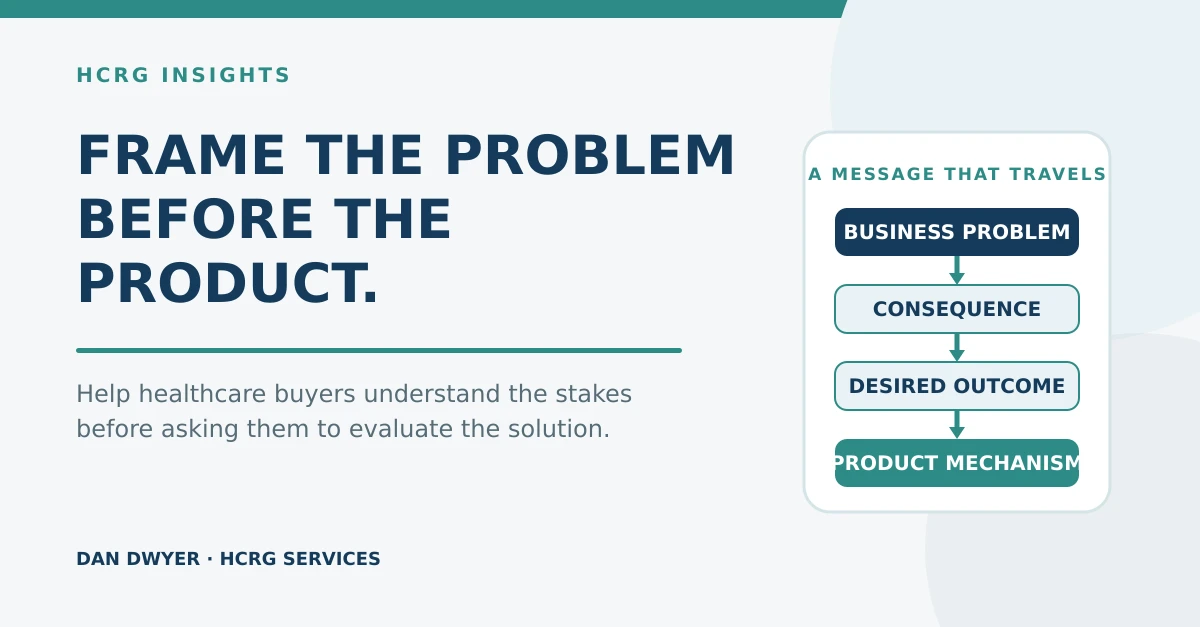
Healthcare buyers rarely mobilize around features. They mobilize around problems that matter to their clinical, financial, and operational priorities.
Dan Dwyer • October 22, 2026 • 4-minute read
The product-description trap
Healthcare technology teams understandably become fluent in the product. They know the features, workflows, analytics, integrations, and differences from competitors. That fluency often shapes the commercial message.
The result is a clear explanation of the solution—but an incomplete reason to act.
Buyers do not typically receive budget and organizational attention because a platform is elegant. They mobilize because a clinical, financial, operational, regulatory, workforce, or strategic problem has become important enough to solve.
Start where the buyer feels the problem
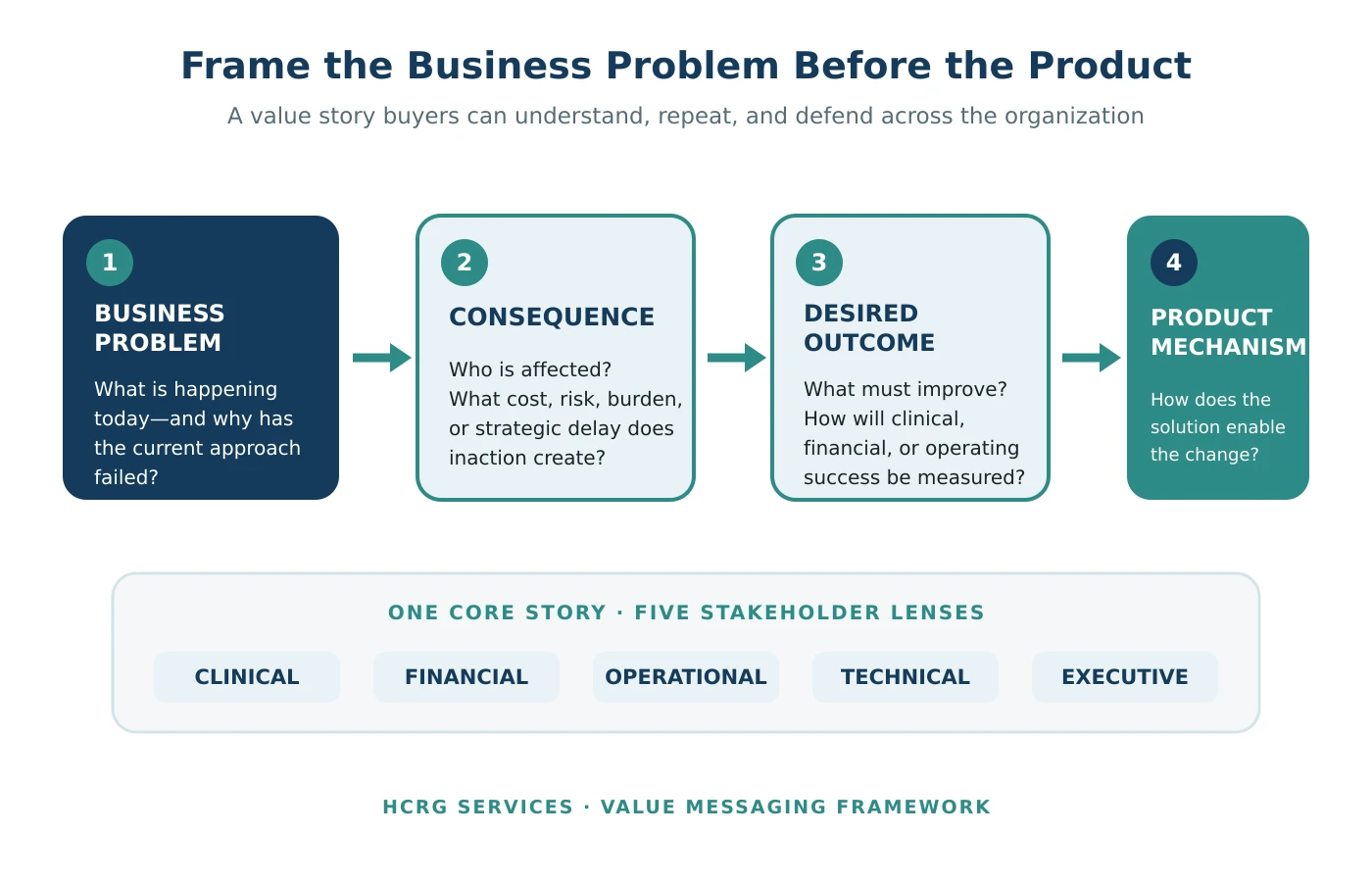
Effective positioning begins with the conditions the buyer recognizes. What is happening today? Who is affected? What outcome is compromised? What is the financial or operational consequence? Why has the current approach failed? Why does the problem matter now?
This requires specificity. “Healthcare organizations struggle with efficiency” is too broad. A useful problem frame identifies the setting, the mechanism of failure, the stakeholder impact, and the consequence.
Build one story for a multi-stakeholder decision
A healthcare buying committee may include clinical, financial, operational, technical, and executive perspectives. The message must flex without fragmenting.
A strong value architecture starts with one central business problem and then expresses its relevance to each stakeholder. The clinical leader sees care or workforce impact. Finance sees economics. Operations sees workflow. IT sees feasibility and risk. The executive sees strategic importance.
If each audience hears an unrelated pitch, the organization is less likely to form a shared decision.
Operator Perspective
Across healthcare technology markets, I have seen strong solutions lose momentum because the seller made the buyer do too much translation. The message becomes more persuasive when the team can name the business problem, show who feels it, make the consequence concrete, and connect the product to a decision the organization can defend.
Make the cost of inaction concrete
Companies often explain the upside of change while leaving the status quo unexamined. Yet doing nothing is the solution’s strongest competitor.
The cost of inaction may include avoidable expense, missed revenue, delayed access, poor quality performance, staff burden, capacity limitations, compliance exposure, customer dissatisfaction, or strategic delay. The objective is not fear. It is accuracy about the consequences of continuing the current approach.
Use the product as the mechanism—not the headline
Once the problem and desired outcome are established, the product has a more powerful role. Features become evidence of how the result will be achieved.
Instead of leading with a dashboard, explain the decision or workflow the dashboard improves. Instead of leading with automation, explain which delay, cost, risk, or burden it removes. Instead of leading with artificial intelligence, explain the measurable operating outcome and the safeguards required for trust.
This approach does not minimize the product. It gives product capabilities business meaning.
Test whether the message can travel
A message is valuable when a champion can repeat it accurately to colleagues who were not in the meeting. Ask whether the problem, consequence, proposed change, expected outcome, and supporting evidence are simple enough to carry across the organization.
If the message depends on a long product demonstration to become relevant, the positioning is doing too little work.
Describe the product clearly—but frame the business problem first. That is how a solution becomes a priority.
A Practical Next Step
If buyers understand your product but struggle to prioritize it, HCRG can help clarify the business problem, stakeholder value, and cost of inaction.
Related Article
Why a Good Product Still Needs a Commercial Operating System
Explore the wider commercial system that connects market focus, value architecture, buyer progress and management discipline.