
Enterprise healthcare deals move when the full buying committee can defend the decision—not merely when one champion believes.
Dan Dwyer • October 27, 2026 • 4-minute read
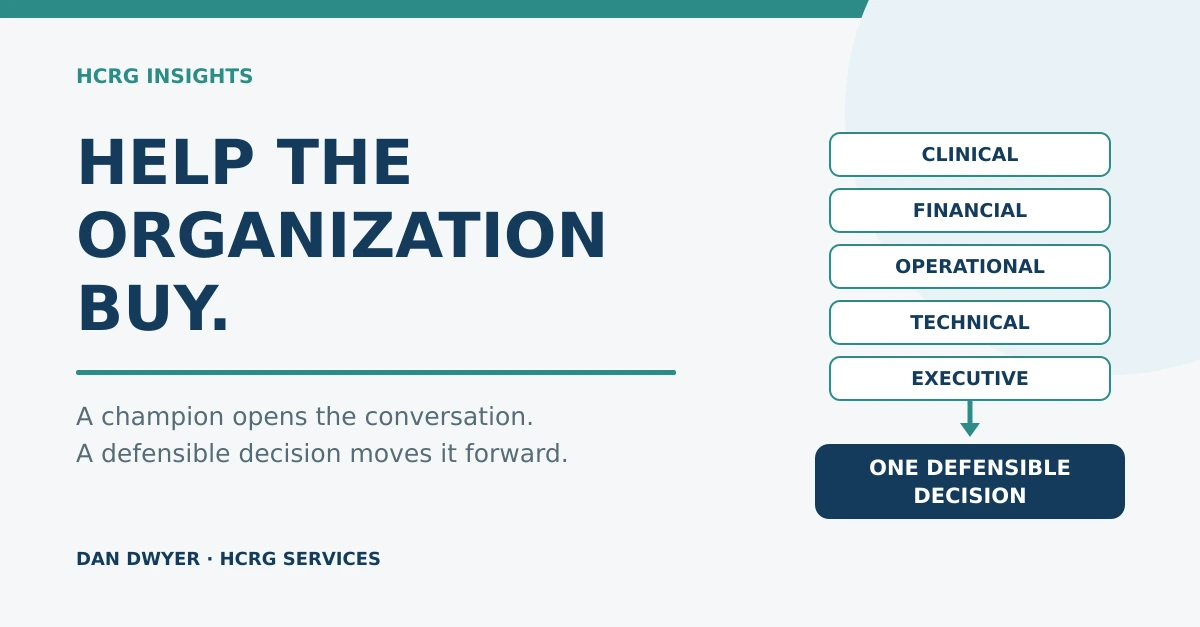
A healthcare sale is a coordinated decision
In complex healthcare markets, enthusiasm is not the same as organizational commitment. A clinical, financial, or operational leader may become a persuasive champion, but most significant purchases also require confidence from finance, operations, IT, security, legal, procurement, and executive leadership.
Each stakeholder evaluates a different category of risk. Clinical teams ask whether the solution improves care or reduces burden. Finance asks whether the economics are credible. IT and security evaluate integration and exposure. Operations considers adoption. Executives consider strategic fit and reputational consequences.
The seller’s job is therefore larger than convincing a primary contact. It is helping the buying organization assemble a decision that can survive scrutiny.
OPERATOR PERSPECTIVE
In complex payer and provider pursuits, the turning point is rarely the product demonstration. It is the moment the organization can connect the problem to its own clinical, financial, operational, and technical priorities—and each stakeholder has enough confidence to support the same decision.
Buyers need a problem important enough to mobilize around
Many solutions address real problems that are not sufficiently urgent to overcome organizational inertia. The first requirement is not product interest; it is agreement that the status quo carries a meaningful clinical, financial, operational, or strategic cost.
Strong discovery makes the cost of inaction visible. It explores where the problem appears, who experiences it, how it is currently managed, what competing priorities exist, and what happens if nothing changes. This is not manufacturing urgency. It is determining whether urgency genuinely exists.
They need a value case each stakeholder can use
A single generic ROI statement rarely carries an enterprise healthcare decision. The value case must connect the solution to the measures and responsibilities of the people involved.
For a clinical sponsor, value might involve outcomes, access, capacity, quality, or workforce burden. For finance, it may involve margin, avoided cost, revenue capture, or resource utilization. For operations, it may be throughput and workflow reliability. For IT, it may be architecture, support requirements, interoperability, and risk.
These are not separate pitches. They are stakeholder-specific expressions of one defensible business case.
They need confidence in implementation—not only the destination
Healthcare organizations have seen promising solutions fail because adoption, integration, data access, workflow design, governance, or change management were underestimated. A credible commercial process addresses implementation early.
Buyers need to understand ownership, timing, technical dependencies, staff impact, decision rights, training, measures of success, and how problems will be escalated. Implementation confidence is part of the sale, not a conversation to postpone until after signature.
They need evidence appropriate to the risk
The higher the perceived risk, the stronger the required proof. References, outcomes, product demonstrations, security documentation, integration plans, and financial assumptions should match the questions the buyer must answer.
A pilot can help, but only when it has a defined business purpose, success measures, owners, timeline, and an agreed decision path. An open-ended pilot often delays commitment rather than reducing risk.
They need a decision process that is visible
One of the most common mistakes in enterprise selling is confusing access with control. A positive champion does not always know the final approval path. Sellers should respectfully establish how the organization will evaluate, approve, contract, implement, and fund the purchase.
This includes identifying who can stop the decision, what evidence each group requires, when committees meet, how budget is released, what legal and security reviews involve, and what competing initiatives may intervene.
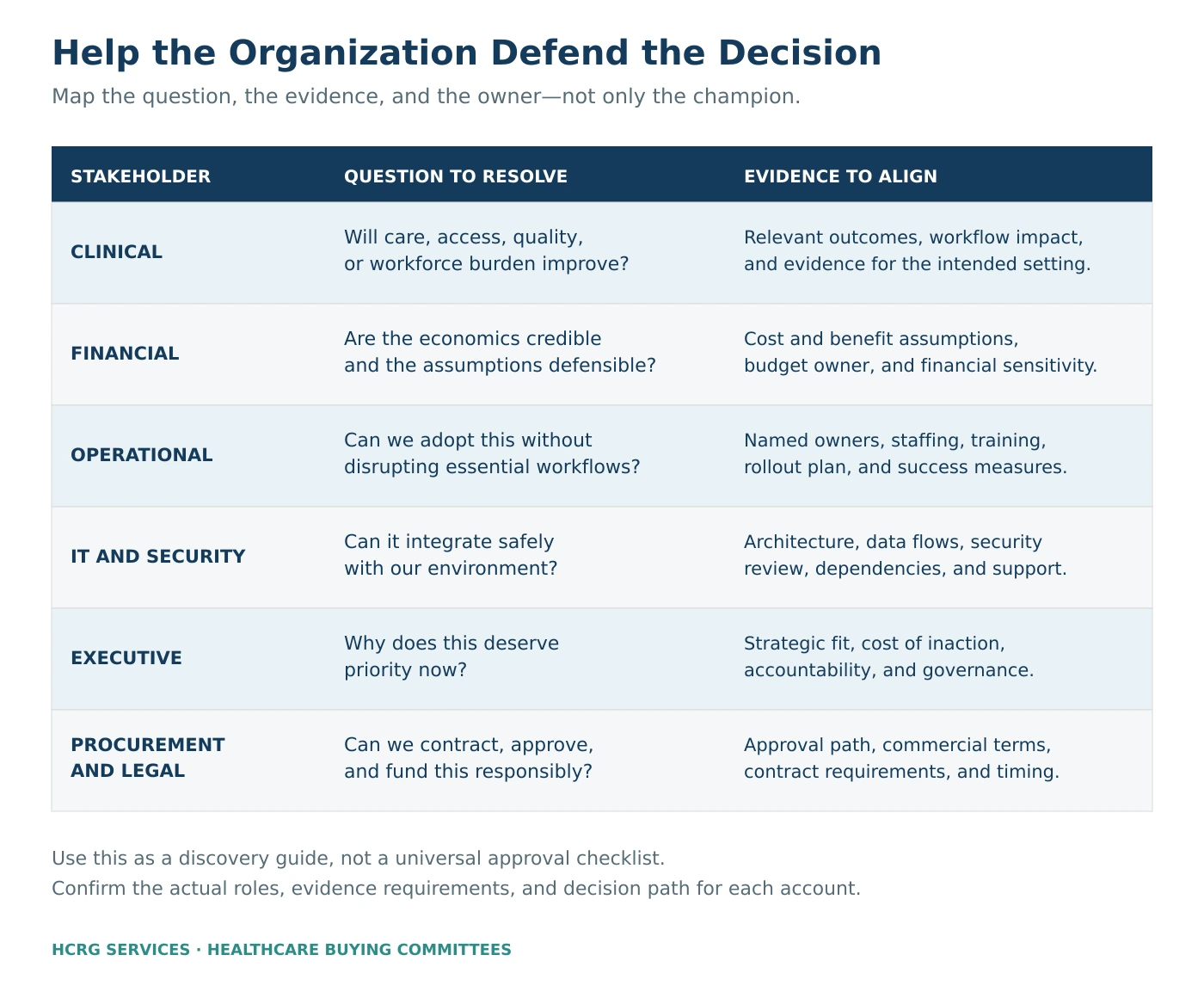
Help the organization buy
The best enterprise healthcare sellers do more than communicate product value. They make a complicated decision easier to understand, coordinate, and defend.
When the problem is urgent, the value case is stakeholder-specific, implementation feels credible, evidence matches risk, and the decision process is visible, the buying organization can move with confidence. That is the point at which interest becomes commitment.
A PRACTICAL NEXT STEP
If promising healthcare opportunities are stalling inside the buying committee, HCRG can help strengthen stakeholder alignment, value architecture, and the path to a defensible decision.